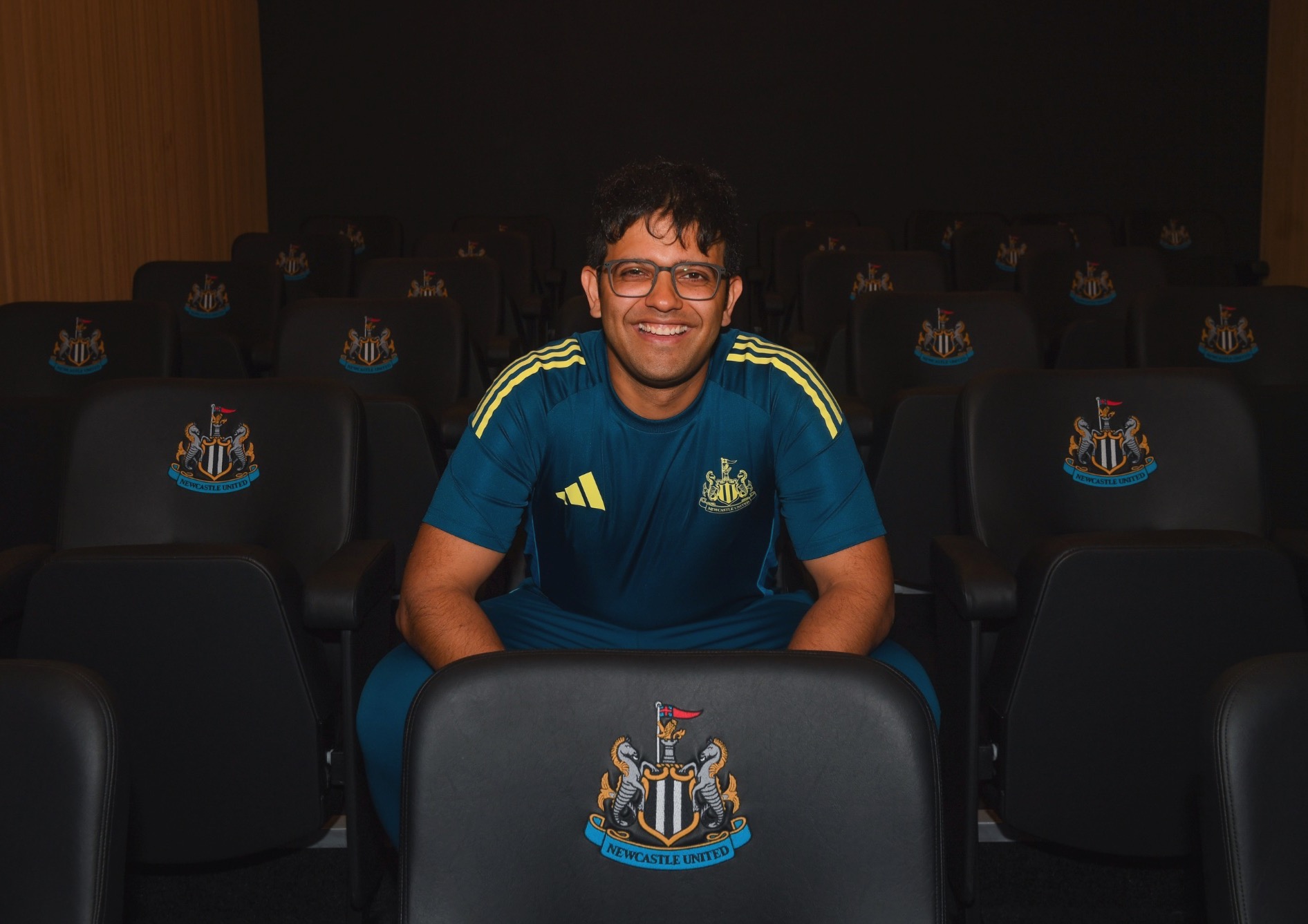
Sudarshan drives data strategy at Newcastle FC
Sudarshan Gopaladesikan is English Premier League footbal club Newcastle United’s Technical Director, one of the key figures guiding how tech is being used in on field performance and player recruitment
On a match night at St James’ Park, home of English Premier League side Newcastle United, when the stadium hums and sways to every pass, tackle, move and goal by home team in black and white jerseys, emotion drives everything. Behind the noise, another game unfolds quietly. This one is built on code, cameras and millions of data points. At Newcastle United, that invisible game is now central to how the club trains, competes, plans the season and even buys players. And helping to run it is an Indian origin technologist whose journey spans American classrooms, Silicon Valley and Europe’s biggest leagues.
Sudarshan Gopaladesikan is Newcastle United’s Technical Director, one of the key figures guiding how tech is being used in on field performance and player recruitment. Technology at the club supports almost every aspect from on the field to off the field commercial and legal departments. His focus though is firmly on the football side. His job is to help players stay fit, help coaches prepare smarter and help the club make better decisions in the transfer market.
The role is heavily dependent on data. And data flow begins almost as soon as a match ends. By the following morning, Newcastle receive detailed digital files from specialist providers. One stream is event data, which logs every on ball action such as passes, shots, tackles and interceptions. A single game can produce three to four thousand such events.
The second stream is tracking data. Stadium camera systems capture the position of every player and the ball around 25 rows per second. Over 90 minutes, that becomes roughly three to four million rows of positional information from just one match. Across an entire season, the volume of tracking data rivals any top sporting event. While the game of football is passionately watched, Sudarshan’s team measure it continuously.
These raw feeds arrive in structured formats such as JSON files and are processed through automated cloud systems at the club. Analysts clean and transform the data before turning it into visual reports, key metrics and short, focused video clips. It is presented to coaches as clear insights linked directly to moments from games.
Sudarshan explains, early in the week, the focus is on reviewing the previous match. Analysts study how Newcastle functioned in possession. Where did they break defensive lines with passes? Where did they struggle to progress the ball? What happened after they regained possession? Out of possession, they look at where chances were conceded and how well the defensive shape held. Set pieces, now responsible for a significant share of goals in top level football, are examined in detail.
These findings feed directly into training. Sessions too are filmed from multiple angles, sometimes using drones, and matched against the tactical priorities identified through data. Coaches narrow the message to a handful of key themes players must carry into the next game. In high pressure sport, clarity often matters more than complexity.
Technology also plays a vital role in monitoring physical performance. Every player’s locomotion is tracked, explains Sudarshan, including total distance covered, maximum speed, acceleration, deceleration and changes of direction. Metrics such as repeated high intensity efforts show whether a player can sprint again and again over short periods, a crucial quality in modern football.
Off the pitch, fitness is monitored through a mix of testing and medical data. Strength assessments of major muscle groups are carried out during pre season and at points through the year. Jump tests help measure explosive power. Blood markers after matches can indicate stress and recovery levels. Body composition is tracked using tools such as DEXA scans, which provide detailed information on muscle mass, fat distribution and bone density. Sleep and diet are also monitored, sometimes through wearable devices and sometimes through detailed questionnaires, depending on how comfortable players are with certain technologies.
All of this context shapes one of the most debated aspects of the modern game: starting team and substitutions. To fans, it can be baffling when a player doesn’t start or one who looks lively is taken off. Inside the club, that decision is often backed by data. Who is fit to start and who has done enough for the day, is based on data assessments.
During matches, Newcastle monitor players in real time using time series models. These track not just how far a player has run, but how many high intensity actions he has performed and how closely they are clustered. A player might look fine to the eye, but the data can show he has reached a physical load that significantly increases injury risk, especially when recent matches and training sessions are taken into account.
With Newcastle competing across multiple competitions, protecting players over a long season is crucial. Substitutions are often about managing cumulative fatigue and ensuring availability for upcoming fixtures. The aim is not only to win that day’s match but to keep key players fit for the weeks and months ahead.
When the transfer window opens, much of the same data underpins recruitment decisions. Newcastle use event and tracking information to build detailed profiles of potential signings. They look beyond statistics, measuring how players move, create space, defend and cope with physical demands.
Context is layered in carefully. Sudarshan explains what all is assessed before signing a player. The strength of the player’s current league matters, as does the style of his team and his specific role within it. Age and physical development curves are considered. Off field variables are just as important. How long is left on his contract affects transfer value and negotiating power. The league position and financial situation of his club influence how a deal might unfold. Country and location bring their own questions about adaptation to a new league, language and lifestyle.
Recruitment, he elaborates, becomes a complex optimisation exercise, balancing performance data, contract details, league strength and financial considerations to find players who best fit Newcastle’s defined way of playing.
Overseeing this data driven system is Sudarshan whose own journey will resonate with many Indian readers. He was born in Harrisburg, Pennsylvania, to parents from Tamil Nadu. He attended Central Dauphin High School before studying mathematics at Swarthmore College, one of the United States’ leading liberal arts institutions. He is currently also part of the Stanford University LEAD Program, an executive education course run by Stanford Graduate School of Business faculty.
His career began in technology at Microsoft, where he worked on the team that developed Power BI. A project with Real Madrid introduced him to elite football. From there, he moved into club roles with Benfica in Portugal and Atalanta in Italy before joining Newcastle United.
His message to Indian technologists is clear. Sport is no longer a niche career path. With billions being invested globally, clubs need people who can build evidence based systems and translate complex analysis into simple, actionable insights. Big clubs need scientific and data based explanations for why they spent big amounts. Formal education helps, but Sudarshan asserts it is important to show ‘skin in the game’. With so much data available online, he suggests techies to analyse that and come up with AI and data backed plans for the clubs to show they deserve the job. He suggests building a visible portfolio using real data and showing genuine passion for the game.
Football, he emphasises, will always belong to the fans in the stands and the players and managers on the pitch. But behind every sprint, every substitution and every signing, a quieter revolution is definitely underway. In that space where sport meets science, an Indian technologist is helping one of England’s most historic clubs navigate their season. He hopes they become one of the ‘top six’ clubs of the league in terms of fan following and performances and his story inspires more Indian fans to cheer for Newcastle.
Post a comment