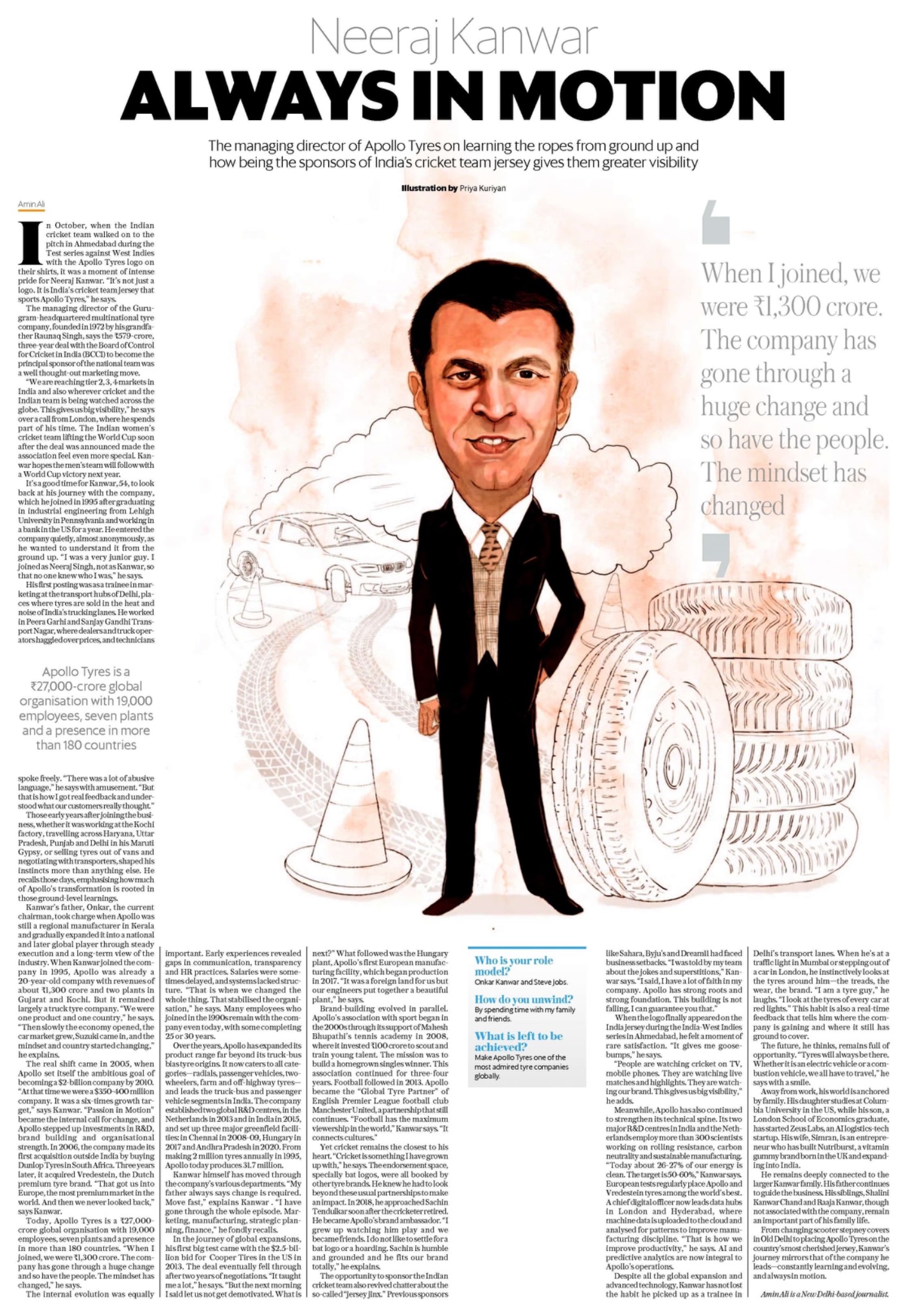
Neeraj Kanwar of Apollo Tyres: Always in motion
The managing director of Apollo Tyres on learning the ropes from the ground up and how it feels to be be the latest sponsors of India’s cricket team jersey
In October, when the Indian cricket team walked on to the pitch in Ahmedabad during the Test series against West Indies with the Apollo Tyres logo on their shirts, it was a moment of intense pride for Neeraj Kanwar. “It’s not just a logo. It is India’s cricket team jersey that sports Apollo tyres,” he says.
The managing director of the Gurugram-headquartered multinational tyre company, founded in 1972 by his grandfather Raunaq Singh, says the ₹579-crore, three-year deal with the Board of Control for Cricket in India (BCCI) to become the principal sponsor of the national team was a well thought-out marketing move.
“We are reaching tier 2, 3, 4 markets in India and also wherever cricket and the Indian team is being watched across the globe. This gives us big visibility,” he says over a call from London, where he spends part of his time. The Indian women’s cricket team lifting the World Cup soon after the deal was announced made the association feel even more special. Kanwar hopes the men’s team will follow with a World Cup victory next year.
It’s a good time for Kanwar, 54, to look back at his journey with the company, which he joined in 1995 after graduating in industrial engineering from Lehigh University and working in a bank in the US for a year. He entered the company quietly, and almost anonymously, as he wanted to understand it from the ground up. “I was a very junior guy. I joined as Neeraj Singh, not as Kanwar, so that no one knew who I was,” he says.
His first posting was as a trainee in marketing at the transport hubs of Delhi, places where tyres are sold in the heat and noise of India’s trucking lanes. He worked in Peera Garhi and Sanjay Gandhi Transport Nagar, where dealers and truck operators haggled over prices, and technicians spoke freely. “There was a lot of abusive language,” he says with amusement. “But that is how I got real feedback and understood what our customers really thought.”
Those early years after joining the business, whether it was working at the Kochi factory, travelling across Haryana, Uttar Pradesh, Punjab and Delhi in his Maruti Gypsy, or selling tyres out of vans and negotiating with transporters, shaped his instincts more than anything else. He recalls those days, emphasising how much of Apollo’s transformation is rooted in those ground-level learnings.
Kanwar’s father, Onkar, the current chairman, took charge when Apollo was still a regional manufacturer in Kerala and gradually expanded it into a national and later global player through steady execution and a long-term view of the industry. When Kanwar joined the company in 1995, Apollo was already a 20-year-old company with revenues of about ₹1,300 crore and two plants in Gujarat and Kochi. But it remained largely a truck tyre company. “We were one product and one country,” he says. “Then slowly the economy opened, the car market grew, Suzuki came in, and the mindset and country started changing,” he explains.
The real shift came in 2005, when Apollo set itself the ambitious goal of becoming a $2-billion company by 2010. “At that time we were a $350–400 million company. It was a six-times growth target,” says Kanwar. “Passion in Motion” became the internal call for change, and Apollo stepped up investments in R&D, brand building and organisational strength. In 2006, the company made its first acquisition outside India by buying Dunlop Tyres in South Africa. Three years later, it acquired Vredestein, the Dutch premium tyre brand. “That got us into Europe, the most premium market in the world. And then we never looked back,” says Kanwar.
Today, Apollo Tyres is a ₹27,000-crore global organisation with 19,000 employees, seven plants and a presence in more than 180 countries. “When I joined, we were ₹1,300 crore. The company has gone through a huge change and so have the people. The mindset has changed,” he says.
The internal evolution was equally important. Early experiences revealed gaps in communication, transparency and HR practices. Salaries were sometimes delayed, and systems lacked structure. “That is when we changed the whole thing. That stabilised the organisation,” he says. Many employees who joined in the 1990s remain with the company even today, with some completing 25 or 30 years.
Over the years, Apollo has expanded its product range far beyond its truck-bus bias tyre origins. It now caters to all categories—radials, passenger vehicles, two-wheelers, farm and off-highway tyres—and leads the truck-bus and passenger vehicle segments in India. The company established two global R&D centres, in the Netherlands in 2013 and in India in 2015, and set up three major greenfield facilities: in Chennai in 2008–09, Hungary in 2017 and Andhra Pradesh in 2020. From making 2 million tyres annually in 1995, Apollo today produces 31.7 million.
Kanwar himself has moved through the company’s various departments. “My father always says change is required. Move fast,” explains Kanwar . “I have gone through the whole episode. Marketing, manufacturing, strategic planning, finance,” he fondly recalls. In the journey of global expansions, his first big global test came with the $2.5-billion bid for Cooper Tires in the US in 2013. The deal eventually fell through after two years of negotiations. “It taught me a lot,” he says. “But the next morning I said let us not get demotivated. What is next?” What followed was the Hungary plant, Apollo’s first European manufacturing facility, which began production in 2017. “It was a foreign land for us but our engineers put together a beautiful plant,” he says.
Brand-building evolved in parallel. Apollo’s association with sport began in the 2000s through its support of Mahesh Bhupathi’s tennis academy in 2008, where it invested ₹100 crore to scout and train young talent. The mission was to build a homegrown singles winner. This association continued for three-four years. Football followed in 2013. Apollo became the “Global Tyre Partner” of English Premier League football club Manchester United, a partnership that still continues. “Football has the maximum viewership in the world,” Kanwar says. “It connects cultures.”
Yet cricket remains the closest to his heart. “Cricket is something I have grown up with,” he says. The endorsement space, specially bat logos, were all booked by other tyre brands. He knew he had to look beyond these usual partnerships to make an impact. In 2018, he approached Sachin Tendulkar soon after the cricketer retired. He became Apollo’s brand ambassador. “I grew up watching him play and we became friends. I do not like to settle for a bat logo or a hoarding. Sachin is humble and grounded and he fits our brand totally,” he explains.
The opportunity to sponsor the Indian cricket team also revived chatter about the so-called “jersey jinx.” Previous sponsors like Sahara, Byju’s and Dream11 had faced business setbacks. “I was told by my team about the jokes and superstitions,” Kanwar says. “I said, I have a lot of faith in my company. Apollo has strong roots and strong foundation. This building is not falling, I can guarantee you that.”
When the logo finally appeared on the India jersey during the India-West Indies series in Ahmedabad, he felt a moment of rare satisfaction. “It gives me goosebumps,” he says.
“People are watching cricket on TV, mobile phones. They are watching live matches and highlights. They are watching our brand. This gives us big visibility,” he adds.
Meanwhile, Apollo has also continued to strengthen its technical spine. Its two major R&D centres in India and the Netherlands employ more than 300 scientists working on rolling resistance, carbon neutrality and sustainable manufacturing. “Today about 26–27% of our energy is clean. The target is 50–60%,” Kanwar says. European tests regularly place Apollo and Vredestein tyres among the world’s best. A chief digital officer now leads data hubs in London and Hyderabad, where machine data is uploaded to the cloud and analysed for patterns to improve manufacturing discipline. “That is how we improve productivity,” he says. AI and predictive analytics are now integral to Apollo’s operations.
Despite all the global expansion and advanced technology, Kanwar has not lost the habit he picked up as a trainee in Delhi’s transport lanes. When he’s at a traffic light in Mumbai or stepping out of a car in London, he instinctively looks at the tyres around him—the treads, the wear, the brand. “I am a tyre guy,” he laughs. “I look at the tyres of every car at red lights.” This habit is also a real-time feedback that tells him where the company is gaining and where it still has ground to make up.
The future, he thinks, remains full of opportunity. “Tyres will always be there. Whether it is an electric vehicle or a combustion vehicle, we all have to travel,” he says with a smile.
Away from work, his world is anchored by family. His daughter studies at Columbia University, while his son, a London School of Economics graduate, has started Zeus Labs, a logistics-tech startup using AI. His wife, Simran, is an entrepreneur who has built Nutriburst, a vitamin gummy brand born in the UK and expanding into India. He remains deeply connected to the larger Kanwar family. His father continues to guide the business His siblings, Shalini Kanwar Chand and Raja Kanwar, though not associated with the company, remain an important part of his family life.
From changing scooter stepney covers in Old Delhi to placing Apollo Tyres on the country’s most cherished jersey, Kanwar’s journey mirrors that of the company he leads—constantly learning and evolving, and always in motion.
Post a comment