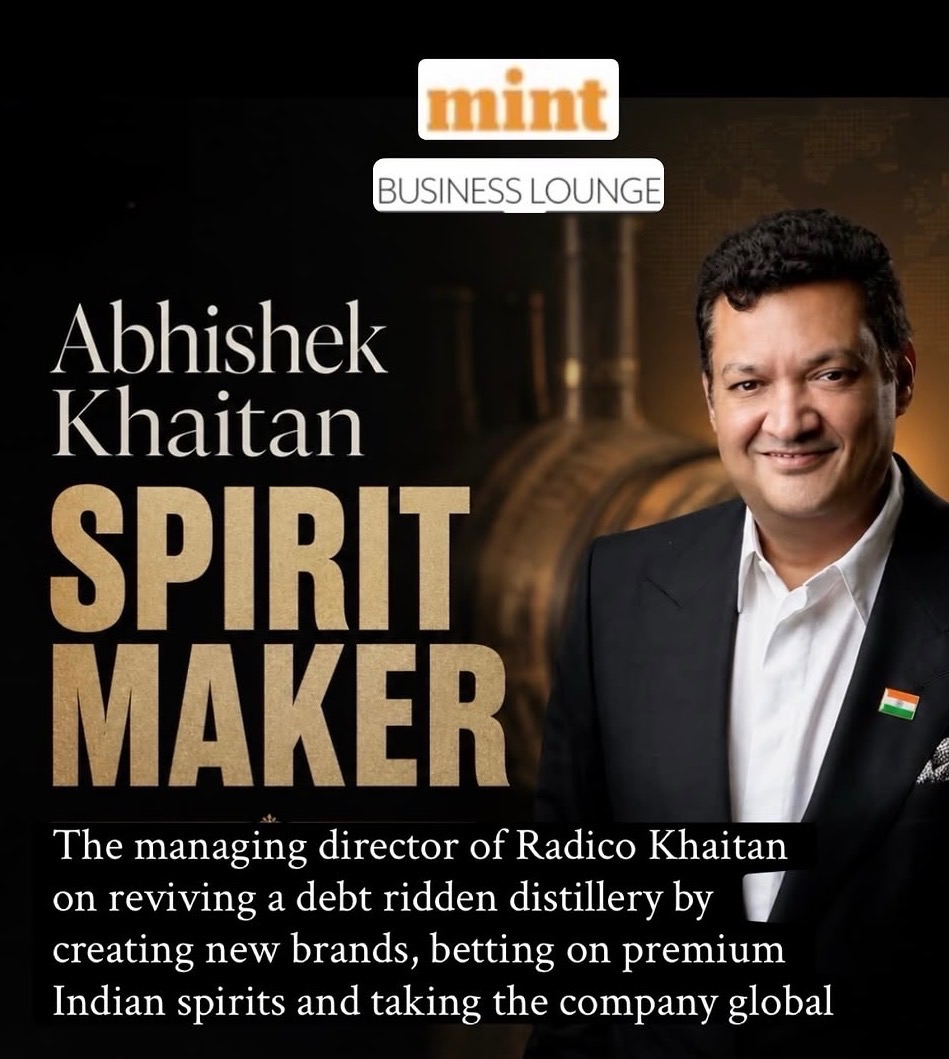
Meet Abhishek Khaitan of Radico Khaitan
In 1996, when Abhishek Khaitan joined Rampur Distillery & Chemical Co. Ltd, his family’s liquor business, it had “its back against the wall”.
The company had a turnover of ₹70-80 crore, ₹50 crore debt and mounting losses. Founded in 1943, it was one of the country’s oldest distilleries with no brands under its own banner, bottling spirits for other brands, and even those contracts had just come to an end. It was a time when liquor giants such as Pernod and Diageo were entering the market and growing, while Rampur Distillery acted and sounded “like a local player”.
Twenty-eight years later, that company is Radico Khaitan, the fourth largest liquor company in India by volume and in FY26, it crossed ₹6,000 crore in net revenue. Its Rampur Indian Single Malt sits in duty-free counters from Dubai to Heathrow and its Jaisalmer gin can be found on shelves in Tesco in the UK. Market capitalisation, which stood at ₹52 crore in December 1999, is around ₹60,000 crore today. The “penny stock” Abhishek, now managing director, inherited has become an investors’ favourite.
The company’s portfolio includes vodka, whisky, Indian single malts and rum and it will soon enter the tequila category. It ships to around 100 countries, has over 1,500 employees, and opened its second distillery in Sitapur in 2023.
Behind this journey, says Delhi-based Abhishek, was a conviction that once sounded foolish: for an Indian company to create products the world would pay a premium for.
Radico’s roots go back to 1943, when the Rampur Distillery began producing alcohol in Uttar Pradesh. Abhishek’s grandfather, G.N. Khaitan, bought the loss-making unit from Vishnu Dalmia in 1972. For over two decades the company survived as a bulk supplier of spirits to Shaw Wallace, and in 1995, when the wider Khaitan family business was divided among four brothers, Abhishek’s father, Lalit, inherited this liquor unit.
Abhishek joined the following year, at age 22, after graduating from BMS College of Engineering in Bengaluru, a city where he had spent as much time studying the pub culture as he had industrial production. He describes himself as “more of a marketing and finance guy who happened to pursue engineering” and do well in class. What he walked into in Rampur was a management crisis—even the marketing and operations team left within his first year.
There was no way forward. “All the time was spent answering collection calls from bankers and investors.” He told his board to make an attempt to revive the company. “It can’t get worse than this,” he remembers saying to his core management team.
Abhishek, now 53, knew they needed a good product of their own to revive the company. But there was no capital or team to speak of. He went to 10 bottling units and asked if they’d bottle a new product he wanted to introduce. All of them wanted a minimum guarantee, or a fixed volume with an upfront payment for the order. He was in no position to commit to that. The Indian liquor trade at the time ran on a distribution monopoly rather than consumer pull. Abhishek wanted to build a brand people asked for by name, not one that was simply pushed on to shelves.
While he had ideas and knew he needed to launch a product, he also had to build a team and keep the company running. He took a gamble and hired around 100 people, almost all in their early 20s, partly because their salary expectations were lower and partly because he wanted fresh ideas and a willingness to do things differently.
In 1997, the company changed its name from Rampur Distillery & Chemical Co. Ltd to Radico Khaitan. Abhishek recalls a three-day boardroom presentation to convince the family that the old name simply could not compete against the multinational giants entering India.
On 8 August 1998, he introduced 8PM Whisky. It was, by Abhishek’s account, among the first Indian whiskies blended with scotch, still IMFL (Indian made foreign liquor) but priced slightly higher than regular Indian whisky to give the mass Indian consumer a taste of the aspiration usually attached to imported scotch. 8PM sold a million cases in its first year.
Between 1998 and 2006, Radico used that momentum to build scale rather than just one hit brand. It launched Old Admiral Brandy, now one of the largest selling brandies in the world by volume, according to Drinks International; Contessa Select Rum; Whytehall whisky in partnership with Bacardi (which the latter bought out completely in 2004); and extensions of 8PM. Company volumes went from roughly a million cases to 10 million during the time.
While the numbers were looking good, debts were still high and profits low. The company’s next inflection point came from an evening at a bar in Las Vegas, sometime around 2004. Abhishek noticed people ordering bottles of Grey Goose, drawn as much to the packaging as the liquid inside.
Vodka’s share of India’s spirits market was around 2%, against 28% globally, and every vodka sold in India at the time was cheap. He saw an opening and decided to work on an Indian vodka that was smartly packaged and available at an attractive price.
Magic Moments Vodka was launched in 2006. It remains Radico’s biggest bet vindicated. The brand now accounts for roughly 60% of India’s vodka market, has expanded to around a dozen flavours, and closed FY26 with sales nearing ₹1,500 crore and 8.6 million cases sold, according to the company’s latest earnings presentation. It was, as Abhishek says, the real turning point of his career. “8PM was my starting point. But my turning point would be Magic Moments. That is where the premiumisation came.”
Two years later, in 2008, they produced Morpheus, an XO (extra old) brandy, priced at nearly double that of the market leader brandy at that time. Morpheus now holds over 60% of India’s premium brandy market and crossed 1.3 million cases in FY26.
While brands were being introduced and business was growing, they were still not profitable. “Till about 2016, I thought of selling my company at least three times,” he says. The worst stretches, by his account, were in the period from 2008-16. Radico’s net debt peaked at ₹947 crore in 2016.
One near-sale went as far as detailed due diligence with a foreign suitor. When that fell through, Abhishek made up his mind that Radico would stay an Indian company, competing with rather than being absorbed by multinationals that dominated the category. He asserts it is difficult for Indian brands to stand up to foreign liquor majors. “They have the legacy and the capital to pump in. There are very few Indian companies that stay in and build a brand in this category. We are one of them,” he says.
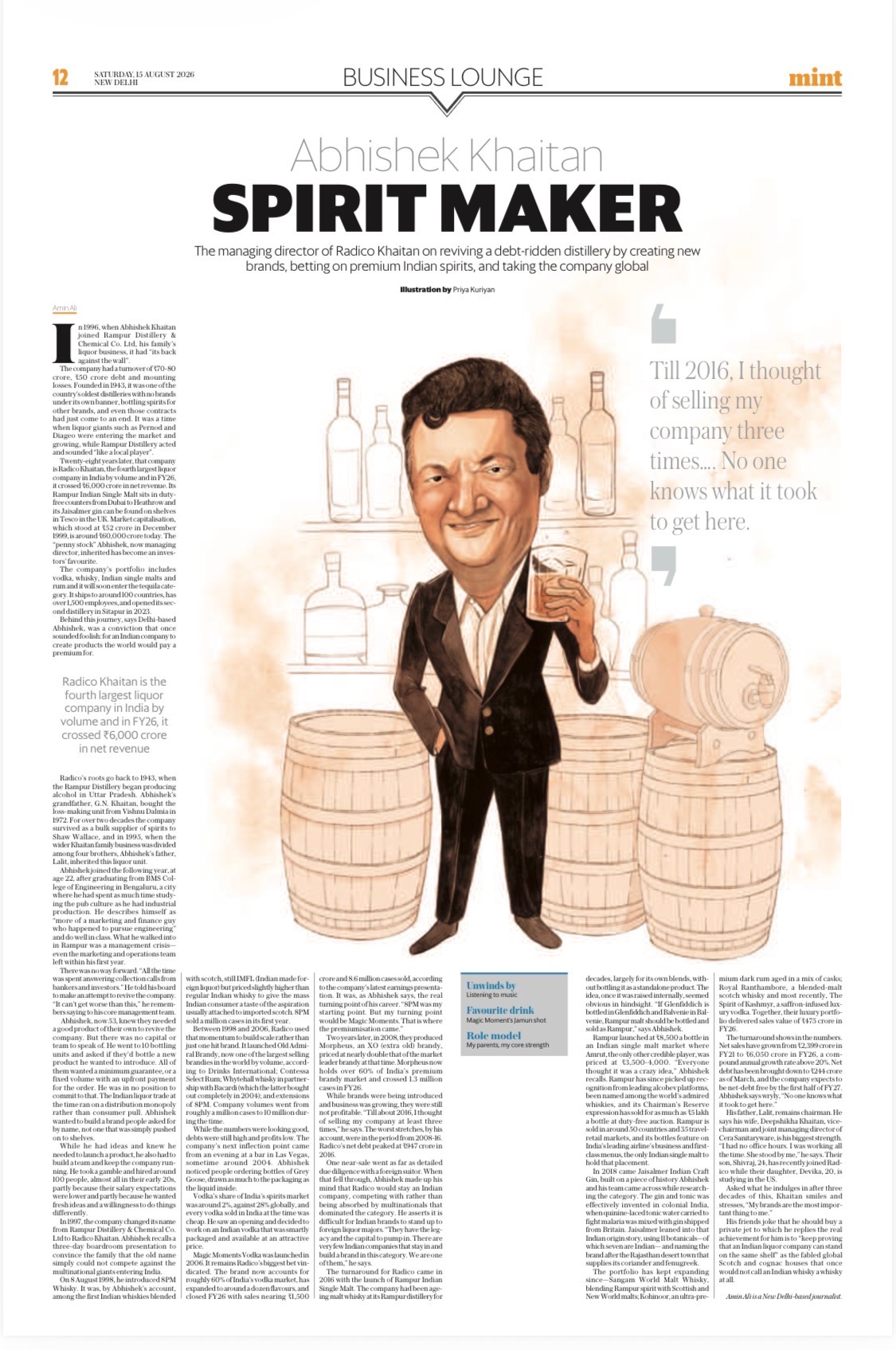
The turnaround for Radico came in 2016 with the launch of Rampur Indian Single Malt. The company had been ageing malt whisky at its Rampur distillery for decades, largely for its own blends, without bottling it as a standalone product. The idea, once it was raised internally, seemed obvious in hindsight. “If Glenfiddich is bottled in Glenfiddich and Balvenie in Balvenie, Rampur malt should be bottled and sold as Rampur,” says Abhishek.
Rampur launched at ₹8,500 a bottle in an Indian single malt market where Amrut, the only other credible player, was priced at ₹3,500-4,000. “Everyone thought it was a crazy idea,” Abhishek recalls. Rampur has since picked up recognition from leading alcobev platforms, been named among the world’s admired whiskies, and its Chairman’s Reserve expression has sold for as much as ₹5 lakh a bottle at duty-free auction. Rampur is sold in around 50 countries and 35 travel-retail markets, and its bottles feature on India’s leading airline’s business and first-class menus, the only Indian single malt to hold that placement.
In 2018 came Jaisalmer Indian Craft Gin, built on a piece of history Abhishek and his team came across while researching the category. The gin and tonic was effectively invented in colonial India, when quinine-laced tonic water carried to fight malaria was mixed with gin shipped from Britain. Jaisalmer leaned into that Indian origin story, using 11 botanicals—of which seven are Indian— and naming the brand after the Rajasthan desert town that supplies its coriander and fenugreek.
The portfolio has kept expanding since—Sangam World Malt Whisky, blending Rampur spirit with Scottish and New World malts; Kohinoor, an ultra-premium dark rum aged in a mix of casks; Royal Ranthambore, a blended-malt scotch whisky and most recently, The Spirit of Kashmyr, a saffron-infused luxury vodka. Together, their luxury portfolio delivered sales value of ₹475 crore in FY26.
The turnaround shows in the numbers. Net sales have grown from ₹2,399 crore in FY21 to ₹6,050 crore in FY26, a compound annual growth rate above 20%. Net debt has been brought down to ₹244 crore as of March, and the company expects to be net-debt free by the first half of FY27. Abhishek says wryly, “No one knows what it took to get here.”
His father, Lalit, remains chairman. He says his wife, Deepshikha Khaitan, vice-chairman and joint managing director of Cera Sanitaryware, is his biggest strength. “I had no office hours. I was working all the time. She stood by me,” he says. Their son, Shivraj, 24, has recently joined Radico while their daughter, Devika, 20, is studying in the US.
Asked what he indulges in after three decades of this, Khaitan smiles and stresses, “My brands are the most important thing to me.”
His friends joke that he should buy a private jet to which he replies the real achievement for him is to “keep proving that an Indian liquor company can stand on the same shelf” as the fabled global Scotch and cognac houses that once would not call an Indian whisky a whisky at all.
Post a comment